

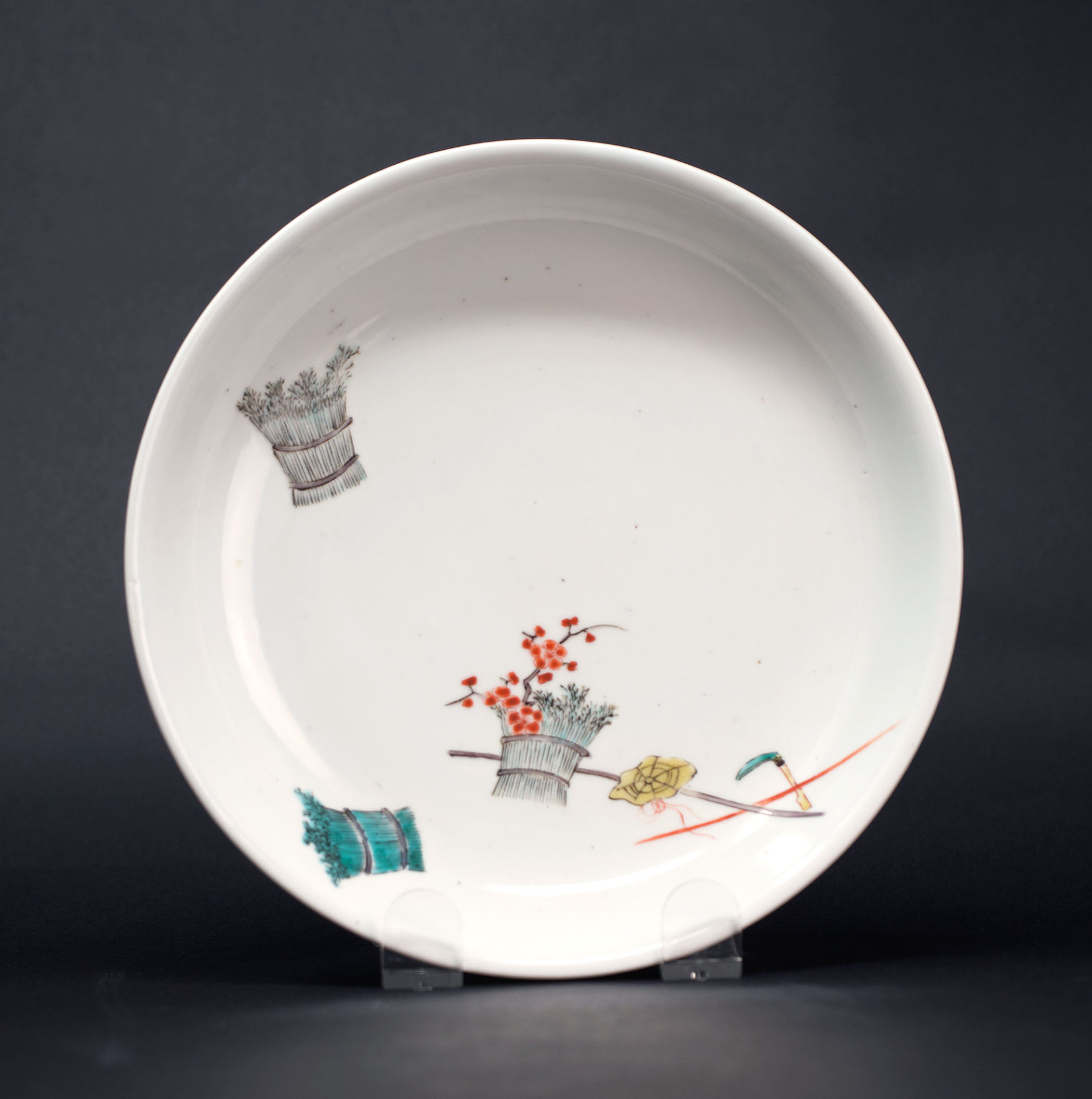

A sublime Arita Kakiemon dish finely enamelled with 'Shiba-taba Kama-kasa' (Firewood, Sickle & Hat) design, representative of a poetic longing for the quiet life of a Hermit
Arita kiln, Kakiemon workshop, Hizen province, Japan
Edo period, Enpo era (1673-1681) - Genroku era (1688-1703)circa 1680-1700
MEASUREMENTS
18.4 cm diameter; 3.5 cm high
CONDITION
In excellent original condition.
DESCRIPTION
The serene, asymmetrical placement of these elements represents a poetic longing for the life of a hermit; one who lives quietly in nature away from worldly concerns. The design evokes an old man who has gone to the mountains to gather firewood, leaning against a bundle of brushwood and resting. This pattern also exists in Ai-Kakiemon (blue Kakiemon) which visually shows the figure of the old man. In this, the enamelled version, the Old Man is absent from the image, but the symbols speak on his behalf. A quietly poetic dish.
This design consists of three main elements that symbolize Japanese rural life and the aesthetics of seclusion:
Shiba-taba (Firewood Bundles): brushwood branches bundled together to be used as fuel.
Kama (Sickle): A curved tool used for cutting the firewood.
Kasa (Straw Hat): A woven hat used to shield one from the elements of Nature.
STORAGE
With a traditional Japanese paulownia wood tomobako storage box and silk ribbon.
A sublime Kakiemon dish enamelled with 'Shiba-taba Kama-kasa', Arita c1680-1700
PRICE UPON REQUEST
BARASET HOUSE FINE ART
416 666 6295
info@barasethouse.com
www.barasethouse.com
COMPARABLE EXAMPLES
An identical dish in the Shibata Collection at the Kyushu Ceramic Museum (Arita, Japan), illustrated in Complete Catalogue of Shibata Collection (2019), no.2080.