


Japanese Porcelain - Sold Archive
An archived selection from our past highlights of Kakiemon, Ko-Kutani, Arita models and Early Enamelled wares.

Kakiemon moulded Nigoshide dish, Arita circa 1670
A highly important and exceptionally fine Kakiemon Maru-ni-mitsu-ichō moulded (Three Ginko Leaves Encircled) nigoshide porcelain dish, exquisitely enamelled with a serene view of Matsushima Bay showcasing two delicate pine and maple groves to the foreground and three sailing ships on the distant horizon returning to the shore
Arita, Kakiemon kiln, nigoshide porcelain, Japan
Edo period (17th century), Enpō era
circa 1670
Measurements
17.7 cm diameter; 2.7 cm high
Condition
In flawless original condition with no damage to the nigoshi-de porcelain body and absolutely no fading, damages or losses to the enamels or iron-oxide glazed rim.
A museum-quality example of sublime beauty.
Provenance
This dish sold at Christie's (London) 14 June 1989, Important Japanese Works of Art, lot 31. (original catalogue included with sale)
This masterfully moulded and lobed circular dish was produced using the finest nigoshi-de milky-white porcelain with a pearly luminescent glaze, superbly press-moulded with three large overlapping ginkgo leaves forming a traditional Japanese motif and family crest known as Maru-ni-mitsu-ichō (丸に三つ銀杏) which translates to 'Encircled Three Ginkos'. During the 17th century, the Maru-ni-mitsu-ichō crest was primarily used by retainers of the Tokugawa Shogunate and various families tracing their roots to the Fujiwara and Minamoto clans. The crest was notably used by Manabe Akifusa (間部 詮房; June 18, 1666 – August 7, 1720), who wielded great power as a shogunate attendant in the mid-Edo period.
The velvety surface enamelled with a sublime view from Matsushima Bay (one of Japan's three celebrated locations of natural beauty), featuring a lookout vantage point with groves of maples and pines in the foreground and three traditional Japanese bezaisen sailing ships on the horizon, returning to the shore.
 |
|---|
 |
 |
 |
 |
 |
 |
 |
 |
 |
 |
Early Enamelled Figures, Kakiemon, Arita, circa 1665
A very early and rare pair of 17th century Kakiemon figures of bijin (Japanese courtesans) wearing uchikake (outer garment) enamelled in the Kakiemon style with kichō panels (Curtains of State) and sylized falling leaves
Arita, Kakiemon style, Hizen province, Japan
Early Edo period, Kanbun Era (1661-1673)
c1660-70
14.5 cm high x 6 cm wide across the base
Provenance:
Christie’s (London) ‘Japanese Works of Art’, 6 & 7 March 1989, lot 321 "A pair of Kakiemon models of bijin" (see final two images for Christie's auction catalogue and lot 321 coloured illustration of the present pair of Kakiemon bijin figures).
Possibly two of the “310 small statuettes” shipped to Holland in 1665 aboard the Nieuwenhoven out of the cargo of the Amerongen from Japan to Batavia.
Literature:
See Christie's (London) "Japanese Works of Art" 7 & 8 March 1989, lot 321, for the present pair with colour illustration.
For an almost identical pair, see Oliver Impey & Christian Jorg "Dragons, Tigers and Bamboo: Japanese Porcelain and Its Impact in Europe; The MacDonald Collection" (The Gardiner Museum of Ceramic Art, 2009), for an almost identical pair of bijin, museum number G05.12.25.1 and G05.12.25.2.
The standing courtesans are modelled wearing the uchikake robe (formal outer garment with no sash) over several luxuriant layers of najajuban (underkimonos) which are decorated in the very early Kakiemon palette of iron-red, green, blue and black enamels.
The large and flowing uchikake robe with draped sleeves is sparingly decorated with stylized maple leaves and rectangular panels known as kichō panels (Curtains of State), which depict room dividers that were used to shield court ladies from the eyes of men. In notable contrast to these privacy panels depicted on the back of their robes, the bijin are modelled coquettishly lifting the front of their outer garments to reveal the kosode (inner kimono) underneath, and to give the viewer a tantalizing glimpse of their delicate feet.
 |
|---|
 |
 |
 |
 |
 |
 |
 |
 |
 |
 |
 |
 |
Large Kakiemon lobed dish, Arita circa 1670-90
A large, impressive and dynamically executed lobed Kakiemon dish strikingly enamelled with three Japanese tiger prawn (kuruma-ebi) and trailing seaweeds
Arita kiln, Kakiemon workshop, Hizen province, Japan
Edo period, Enpo era (1673-1681) - Genroku era (1688-1703)
circa 1670-1690
Measurements
23.5 cm diameter; 4.0 cm high
Condition
In excellent original condition.
The asymmetrical placement of boldly rendered Japanese tiger prawns is grounded by the delicate brilliant-green enamelled trailing seaweeds that wrap around the outer edge of the dish to the reverse. The elegantly lobed form is edged with a classic iron-oxide fuchi-beni rim, and the footrim encircled with red concentric rings. A very rare, striking and very impressive dish with a bold presence.
During the Edo period, the Japanese tiger prawn (kuruma-ebi) played an integral role in shaping traditional Japanese food culture. The large tiger prawns were caught in the warm waters of Tokyo Bay (then called the Edo Sea) and became the defining symbol of luxury for the booming city of Edo (modern-day Tokyo) as a key element in the establishment of the Edomae (Edo-style) sushi experience. Early sushi masters discovered that boiling the tiger prawn brought out a bright, beautiful red colour which quickly became one of the most prestigious, essential toppings for authentic Edomae sushi. The large prawns were a highly prized delicacy and a symbol of high-class dining.
 |
|---|
 |
 |
 |
 |
 |
 |
 |
 |
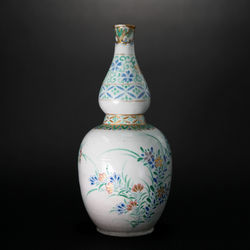
Ko-Kutani Ninsei type Tokkuri (Sake Bottle), Arita kiln, circa 1655
An exceptionally rare and important early Ninsei type Ko-Kutani
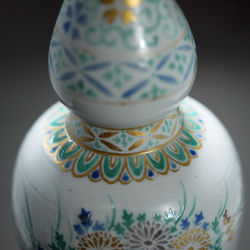
double-gourd tokkuri (sake bottle), gracefully decorated with The Flowers of Autumn, kiku (chrysanthemum), fujibakawa (mistflower), kikyo (balloon flower), nadeshiko (dianthus pinks), and susuki (grasses)
Early overglaze enamelled ware with gilding, Ko-Kutani Nonomura Ninsei type 古九谷仁清手, Arita or Kaga kiln, Japan
Edo period (mid 17th century)
circa 1655
Measurements
21.5 cm high
Notably, the enamels and decoration lack the typical black outlining seen in the early Arita Kakiemon wares and adopted from the Chinese style of black outlining with coloured enamels. This manner of polychrome enamel decoration without black outlining is known as Ninsei-style and credited to Nonomura Ninsei, who is said to be the founder of Kyoto enamelled ware.
Though documentation from this early period is scarce, scholars note the close connection between the two forefathers of Japanese overglaze enamelling which rapidly developed in the 1640s, namely Sakaida Kakiemon I and Nonomura Ninsei. Kakiemon established his workshops in the village of Arita, while Ninsei opened Omuro kiln at the gates of Ninna-ji Temple in Kyoto by 1647. Ninsei is the most historically documented Japanese potter of the Edo period, and was recognized as a Master Potter by the mid 17th century.
In the mid-1650s, Ninsei's elegant enamelling style - which was highly regarded and sought after by Japanese nobles - experienced a very brief period of production on the white porcelain clay of Arita and in Kaga. This resulted in a small and unique group of wares showcasing these brilliantly coloured enamels against stark white porcelain - a contrast to Ninsei's Kyoto wares on yellow-tinged pottery. Due to the incredibly brief period of manufacture in Arita, these scarce early Ninsei-style ko-Kutani porcelain pieces are very rarely seen outside of major museum collections.
Condition
Elegant kintsuji repair to the upper section of the neck. An original superficial surface firing crack extending from the base upwards towards the belly amongst the chrysanthemum enamelling - this does not penetrate to the interior, allowing the sake bottle to still retain liquid.
 |
|---|
 |
 |
 |
 |
 |
 |
 |
 |
 |
 |
 |
 |
 |
 |
 |
 |
'Benkei & The Giant Carp' figural ewer, Arita kiln, circa 1700
A rare Arita "Benkei and The Giant Carp" figural ewer modelled in the form of a Japanese warrior riding a giant carp, decorated in underglaze blue, and enamelled in the Kakiemon palette of red, green, purple, and black enamels with gilt highlights, the carp's mouth agape for pouring liquid and with apertures in the warrior's kimono sleeves for filling the vessel
Arita kiln, Kakiemon type enamelling, Hizen province, Japan
Edo period (late 17th / early 18th century)
circa 1700
Measuring 25.0 cm long, 14.5 cm high, 7.8 cm wide
A rare and superbly intact Arita figure of "Benkei and The Giant Carp", modelled in the form of a young Japanese warrior riding astride a giant carp naturalistically moulded with scales, bulging eyes, undulating whiskers and decorated in underglaze blue with patches of gilding, the boy wearing an iron-red warriors cloth band tied around his head, his expression showing fierce determination, his body clad in a kimono which has slipped off his left shoulder, his sleeves billowing and pierced open, his kimono enamelled in the Kakiemon palette with green and aubergine spots, black obi and bordered with iron-red trim.
Identical examples of this model can be found in The Ashmolean Museum (Oxford), The Princessehof Museum (Leeuwarden), and The National Museum of Korea (Seoul).
Condition report:
In superb original condition with only minor rubbing to the gilding and some minor areas of the enamels.
 |
|---|
 |
 |
 |
 |
 |
 |
 |
 |
 |
 |
 |
Kakiemon Nigoshide deep bowl, Arita circa 1670-90
An outstanding Kakiemon nigoshide porcelain deep bowl superbly enamelled to the interior with a scene of a shishi (Chinese lion) trotting beneath a flowering tree peony, the exterior wall elegantly encircled by a meandering scroll in overglaze blue enamel highlighted by iron-red florets
Arita, Kakiemon kiln, nigoshide porcelain, Japan
Edo period (17th century), Enpō era
circa 1670-1690
Measurements
18.2 cm diameter; 8.0 cm high
Condition
In excellent original condition with no damage to the nigoshi-de porcelain body and absolutely no fading, damages or losses to the enamels or iron-oxide glazed rim. An original glazed potters ‘notch’ to the edge of the footrim. A museum-quality example.
Exhibition History
Exhibited at the Tobi Art Fair, Tokyo Art Club (Japan) by Otani Fine Art, October 2023.
Publication History
Illustrated in Otani Bijutsu 'Kakiemon and Ninsei-style' (Tokyo) 2023, no. 10. Catalogued as "Kakiemon lion and peony design bowl, 1670s-1690s." (original publication included with sale)
This deep circular bowl was produced using the finest nigoshi-de milky white porcelain with a pearly white luminescent glaze. The enamelling, potting, glaze and porcelain body are of the very highest quality, exemplifying the peak achievements of the Kakiemon workshop. An extremely rare and unusual pattern. An exhibited & published piece showcasing the outstanding beauty and elegance of Kakiemon.
 |
|---|
 |
 |
 |
 |
 |
 |
 |
 |
 |
 |
Ruri Ai-Kakiemon Moulded Dish, Arita circa 1670
A superb pale ruri (lapis lazuli) glazed Ai-Kakiemon moulded origami-shaped dish, the extraordinary sharply sculpted form creating a sumptuous trompe l'oeil of masterfully moulded and painted cherry blossoms spilling out from folded origami paper
Arita, Kakiemon kiln, Japan
Edo period (17th century), Enpō era
circa 1670
Measurements
17.0 cm long; 13.6 cm wide; 3.0 cm high
Condition
In excellent, original condition with no damage to the porcelain body. Original, slightly darkened edges and kiln grit from firing. A museum-quality example.
A masterpiece of form and decoration, with an identical example featured on the cover of the Shibata catalogue, this sharply sculpted origami-shaped dish is an iconic example of ruri ko-Kutani at its zenith. The front and back are coated in a velvety pale lapis lazuli glaze which showcases the exquisitely painted cherry blossoms and leaves cascading over the folded-paper form. The reverse with four very finely drawn characters which may be translated to read "made in the year of wealth & honours".
An identical dish in the Shibata Collection at the Kyushu Ceramic Museum (Arita, Japan), illustrated in Complete Catalogue of Shibata Collection (2019), no.1487. Another identical dish with very similar kiln grit adhesions fused into the glaze, in the Toguri Museum of Art (Tokyo, Japan).
Remarkably, The Toguri & Shibata museum examples are very likely decorated by the same hand as the present example.
 |
|---|
 |
 |
 |
 |
 |
 |
 |
 |
 |
 |
 |
 |
 |
 |
 |
 |
 |
'Pair of Kakiemon ShiShi water droppers, Arita kiln, circa 1700
An extremely rare and characterful pair of Kakiemon suiteki (water-droppers) modelled in the form of recumbent shishi (Chinese Buddhist lion-dogs), enamelled in a vibrant Kakiemon palette of green, blue and puce enamel, with black outlining and iron-red
Arita, Kakiemon kiln, Hizen province, Japan
Edo period (late 17th/early 18th century)
Measuring 14.5 cm long (Shishi A); 12.0 cm long (Shishi B)
Finely modelled, the beasts recumbent with heads slightly turned and raised in an alert pose, the eyes clearly cast and picked out in black outlining, both nostrils pierced (as double water-drop holes) and rimmed in iron-red above outlined lips baring canine teeth, the ribs indicated by a series of deep striations enamelled in puce, tight puce coils of fur at the spine terminating in a pointed iron-red tail swept to one side, each leg lined with a ridge of puce fur above the finely cast and moulded paws.
It is notable that the colour palette bears striking similarity to the two documentary seated shishi at Burghley House - featuring predominantly green and blue with puce being included, yet unusually the oft-used yellow enamel fugitive in both of these models.
One other known example of Shishi A was sold Sotheby's (London) Japanese Works of Art, 19 June 2001, lot 307, described in the catalogue as "A Kakiemon Suiteki (Water-dropper) in the form of a recumbent shishi, each nostril and one shoulder pierced with a hole, painted in green, blue and yellow enamels with black outlines and small areas of iron-red". The catalogue notes that "while numerous Kakiemon models of shishi are known, usually sitting on their haunches, waterdroppers are rare."
 |
|---|
 |
 |
 |
 |
 |
 |
Kakiemon Kendi with Phoenix, Arita circa 1660-80
An extremely rare & gorgeously enamelled early Kakiemon kendi-form vessel (gorgelet), the bulbous body very finely decorated with iron-red, blue, green and black enamels featuring two large lotus-shaped panels separated by a flamboyant blue and green phoenix, with integral gourd-form spout terminating in an enamel blue-washed nipple, the cylindrical neck with flared lip decorated with clouds
Early Enamelled Ware, Kakiemon type, Arita kiln, Hizen province, Japan
Edo period (mid 17th century)
circa 1660-80
Measurements
22.0 cm high, 17.5 cm wide
Condition
In very fine original condition with only minor rubbing to enamels and very minor glaze crazing.
The bulbous body with gourd-form spout very finely decorated in iron-red, blue, green and black enamels with two large lotus-shaped panels separated by a flamboyant blue and green phoenix, the cylindrical neck decorated with Chinese Transitional style tulips motifs and terminating in an extruded lip with stylized clouds, the mammiform spout decorated with stylized clouds with the nipple covered in blue enamel.
The kendi is an ancient form of drinking vessel widely used across Asia with no handle; one holds the vessel by the neck and drinks from the spout. As noted by Volker (1954), the shipping records from the Netherlandish VOC trading ship Buienskerke (sailed from Nagasaki 4 November 1662) list 50 Japanese gorgoletten as part of their porcelain cargo destined for Holland; Volker identifies the gorgelet as a kendi-form vessel.
With a Japanese wood storage box and ribbon tie.
 |
|---|
 |
 |
 |
 |
 |
 |
 |
 |
 |
 |
 |
 |
 |
 |
 |
 |
 |
 |
 |
 |
 |
Proto-Kakiemon early enamelled vase & cover, Arita kiln, circa 1650
An extremely rare proto-Kakiemon Early Enamelled Ware 'Willow World' jar and cover, of squat ovoid form with short neck, painted with fluid artistry in a very early palette of vibrant green and blue enamels, black outlining and deep iron-red featuring a continuous landscape scene with a pair of row boats in a bay and small huts on a promontory beneath cascading willow and pine trees
Early Enamelled ware, Proto Kakiemon type enamelling, Arita kiln, Hizen province, Japan
Edo period (mid 17th century)
circa 1650
Measurements
12.0 cm high by 9.0 cm wide
An exceptionally rare proto Kakiemon Early Enamelled Ware jar / vase and cover, of squat ovoid form with short neck, painted with fluid artistry in very early vibrant green and blue enamels, black outlining and deep iron-red featuring a continuous lake scene with a pair of row boats in a bay and small huts on a promontory dotted with spruce and pine trees, all beneath the cascading branches of a willow tree. An iron-red continuous hatched band around the shoulder, concentric iron-red rings around the lower section and footrim. The cover similarly decorated with a 'Willow World' continuous landscape scene bordered by concentric iron-red rings, the squat knop undecorated. It is notable that the enamels of this early example lack the later, oft-used yellow enamel.
Note: a similar example of this exceedingly rare jar can be found in The Ashmolean Museum (Oxford), Reitlinger gift, noted by Dr. Oliver Impey as "a very rare small version of the jar....early enamelled ware....landscape with sketchy indications of hills, pines, drying nets, junks and willow tree" (Impey Japanese Export Porcelain, 2002, p.70).
Condition
In original unrestored condition with small, ancient chip to the footrim, otherwise excellent condition.
 |
|---|
 |
 |
 |
 |
 |
 |
 |
 |
 |
 |
 |
 |
 |
 |
 |
 |
 |
 |
 |
 |
|
ko-Kutani/ko-Nabeshima bowl, Arita circa 1648-55
A highly refined Ko-Kutani/Ko-Nabeshima transitional teabowl enamelled with twin ho-o birds (phoenix) in flight, encircling an underglaze cobalt blue medallion of scrolling octopus arabesques rendered in two-tone lapis-lazuli, the reverse exquisitely painted in the Nabeshima taste with three hanakarakusa (flower-and-arabesque pattern)
Arita kiln, Ko-Kutani/Ko-Nabeshima transitional ware, Hizen province, Japan, Edo period, Keian-Joo era (1648-1655)
circa 1648-55
Measurements
14.6 cm diameter x 5.1 cm high
Condition
In very good condition with no wear to the brilliant enamels. One miniscule fleabite to the edge of the footrim. A tiny notch to the porcelain rim edge of the bowl - likely original and glazed over. One very faint hairline extending from the rim approximately 1.5cm.
The exterior underglaze blue arabesque patterns of this highly refined wide and shallow teabowl are characteristic of those found on Ko-Nabeshima (early Nabeshima) ware. This enamelled and underglaze blue teabowl appears to be a rare transitional work created during the evolution from the Ko-Kutani style toward the Ko-Nabeshima style.
An important and highly rare transitional piece, linking the two lineages of Ko-Kutani and Nabeshima.
With a Japanese wood storage box and ribbon tie.
 |
|---|
 |
 |
 |
 |
 |
 |
 |
 |
 |
 |
 |
 |
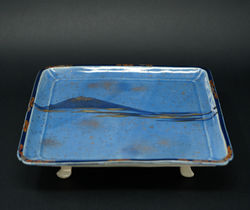
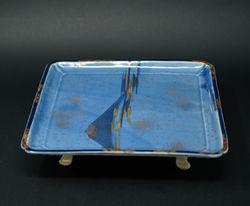
Ruri Ko-Kutani footed tray, Arita circa 1655-60
A magnificent & very rare Fuji-yama Ko-Kutani footed tray, the surface covered in a soft ruri (lapis lazuli) glaze and superbly enamelled with a kin-ginsai (gold and silver) scene of Mount Fuji, it's majestic peak rising above low-hanging clouds with gold fukizumi (blown ink) scattered snow
Arita, Chokichidani kiln, Ko-Kutani ruri kin-ginsai type, Japan
Edo period (mid-17th century), Meireki-Manji era
circa 1655-60
Measurements
19.0 cm long; 19.0 cm wide; 4.2 cm high
Condition
In excellent original condition with no losses or wear to the gilding. Minor glaze hairline.
Of square sided form with bevelled and indented corners, the flattened lip decorated with dark cobalt edging, highlighted by scrolling tendrils in iron-red and gilding, the well softly dressed in pale blue ruri (lapis lazuli) glaze scattered with gold fukizumi (blown ink) snow drifts. The snow-covered peaks of Mount Fuji rising asymmetrically to the left of the well, appearing as an apparition above the low-hanging and slowly drifting golden clouds. A clump of dark cobalt grasses asymmetrically placed in the lower right foreground. The tray elegantly raised on four scroll feet. The flat underside left unglazed.
An almost identical square footed dish with ruyi (lapis lazuli) glaze and kin-ginsai (gold and silver enamel) decoration of Mount Fuji is found in the Shibata Collection at the Kyushu Ceramic Museum, illustrated in Complete Catalogue of Shibata Collection (2019) no.738.
 |
|---|
 |
 |
 |
 |
 |
 |
 |
 |
 |
 |
 |
 |
 |
 |
Kakiemon/ko-Nabeshima lozenge-shaped dish, Arita circa 1650-80
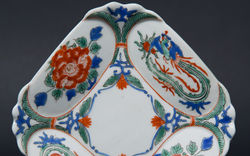
A very fine and rare Kakiemon lozenge-shaped dish in the Nabeshima taste, elegantly moulded and exquisitely enamelled with a pair of Immortal Phoenix (ho-o birds) chasing the Sun
Arita, Kakiemon enamelling (the body possibly early Nabeshima), Japan
Edo period (17th century)
circa 1650-80
Measurements
14.6 cm wide; 13.6 cm long
Condition
Excellent original condition, with a small 6mm glazed notch on the side of the rim. The enamels in exceptional condition.
The superbly moulded porcelain body exquisitely decorated in the Kakiemon style with polychrome enamels of iron-red, deep blue, turquoise green, and black. The reverse sides with underglaze cobalt blue chrysanthemum and arabesque scrolls. The body and high foot formed with the "thread cutting" technique, which is one of the hallmarks of Nabeshima ware. Sherds from the same moulds and with identical underglaze cobalt blue decoration to the underside were uncovered at the historical Nabeshima clan kiln site of Okawachiyama.
The pairing of the Peony (The King of Flowers) with the Immortal Phoenix (The King of Birds) represents a highly auspicious design that promises blessings and prosperity.
With a Japanese wood storage box and ribbon tie.
 |
|---|
 |
 |
 |
 |
 |
 |
 |
 |
 |
 |
Early Enamelled ko-Kutani dish, Arita circa 1648-55
A very fine and rare Early Enamelled Arita Aote Ko-Kutani non-biscuit (namagake) porcelain dish depicting seaweed, algae & clam shells
Arita kiln, Early Enamelled ware, Ko Kutani type or an early enamellers workshop in the Aote palette, Hizen province, Japan
early Edo period, Keian-Joo era (1648-1655)
circa 1648-55
Measurements
21.0 cm diameter x 2.7 cm high
Condition
Excellent original condition with virtually no wear to enamels. Slight depression to the centre due to natural sagging in the kiln.
This early Arita-kiln porcelain of circular form with gently flared rim is uniquely painted with a very unusual combination of enamelled colours in the Aote ko-Kutani palette (brilliant deep green, mustard yellow, and bold aubergine, with black outlining) yet also demonstrating a refined use of blank space, as later adopted by the Kakiemon. An unusual transitional piece. The underside undecorated.
With a Japanese wood storage box and ribbon tie.
 |
|---|
 |
 |
 |
 |
 |
 |
 |
 |
 |
Ruri Ko-Kutani kin-ginsai water dropper, Arita kiln, circa 1655-60
An extremely rare and important Ko-Kutani suiteki water dropper in the form of an aubergine (eggplant), the surface covered in a rich lapis lazuli ruri glaze and enamelled with a landscape and pavillion scene in red enamel, gold and silver ginsai decoration
Ko-Kutani ruri ginsai type, Arita kiln, Hizen province, Japan
Edo Period (mid-17th century), Meireki-Manji period
circa 1655-60
Measurements
7.5 cm in height by 7.5 cm in length
Condition
In pristine original condition.
Of extraordinarily finely modelled naturalistic form, the substantially potted bulbous body in the form of an eggplant, covered with an extremely pleasing ruri blue ground (lapis lazuli) glaze, the body enamelled with gold, silver and red decoration depicting a hut on an rocky embankment surrounded by pine trees, the naturalistically moulded leaves of the eggplant picked out with gold and red enamel, the stem of the eggplant opening to an upwards-pointing mouth with a small pierced airhole nearby among the leaves. The base unglazed.
The form is likely derived from Chinese examples of the Ming dynasty, such as the eggplant water-dropper in The British Museum PDF B694 described as "Porcelain water-dropper in form of an aubergine with stem-shaped spout with relief leaves....Naturalistic details painted on the leaves and stem. Ming Dynasty circa 1590-1610".
In 1659, Zacharias Wagenaer, Principal of the Dutch East India Company in Japan, sent a small shipment back to the VOC Directors in Amsterdam comprising an assortment of Japanese porcelain of his own choosing. He wrote in his report of 10th December 1659: "....I had contracted with a certain person for about 200 pieces after my own invention, to be made curiously on a blue ground with small silver and gold tendrilwork" (T. Volker 1954, p.136). These blue ground pieces called ruri Kutani were among the earliest Japanese porcelains shipped to Europe, according to Dr. Oliver Impey. The striking early blue ground Arita wares are extraordinarily rare but examples do exist in the British Museum, the Groningen Museum, and Hampton Court (London, UK). No other known comparable Ko-Kutani examples of this eggplant calligraphy water dropper form have been found.
 |
|---|
 |
 |
 |
 |
 |
 |
 |
 |
Early Enamelled ko-Kutani dish, Arita circa 1650-55
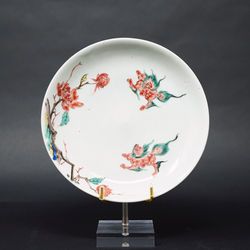
A very fine and rare Early Enamelled Arita Ko-Kutani / transitional Kakiemon porcelain dish depicting an exuberant pair of frolicking Shishi (Chinese Buddhist lions) and Tree Peony
Arita kiln, Early Enamelled ware, Ko Kutani/early Kakiemon style, Hizen province, Japan
early Edo period, Joo era (1650-55)
circa 1650-55
Mark
A brilliant deep green 'Fuku' mark within black double square.
Measurements
14.7 cm diameter x 2.6 cm high
Condition
In excellent original condition. A minuscule fleabite on the footrim base less than 1mm. Sand adhesion to the footrim.
This very early and finely potted Arita-kiln non-biscuit (namagake) porcelain of circular form with gently flared rim is covered with a soft glaze, the interior superbly painted with a pair of iron-red and green spotted shishi lions playfully frolicking near a large Tree Peony, elegantly enamelled with pale yellow, brilliant blue, turquoise green, aubergine-brown and iron-red, with black outlining. The underside is decorated with three enamelled floral sprigs asymmetrically placed. This early enamelled dish is categorized as so-called Ko Kutani made in Arita, yet demonstrates many compositional design qualities and an exceptional use of 'blank space' which became characteristic of the Kakiemon workshop. It is likely that this dish was decorated by an early enamelling workshop which may have been a predecessor of or related to the Kakiemon.
 |
|---|
 |
 |
 |
 |
 |
 |
 |
 |
 |
Ninsei-type dish, Arita circa 1660-80
A very rare early Ninsei type 仁清手 Ko-Kutani dish of superb quality and pristine condition, elegantly decorated with a water scene featuring two wooden boats heavily laden with cherry blossoms, peonies and brushwood bundles, floating atop gold and silver waves, and beneath low-lying clouds of gold fukizumi (blown ink)
Early overglaze enamelled ware with gilding, Ko-Kutani Nonomura Ninsei type 古九谷仁清手, Arita or Kaga kiln, Japan
Edo period (mid 17th century)
circa 1660-80
Measurements
14.5 cm diameter; 2.5 cm high
Condition
In extraordinary pristine original condition.
The pristine early nigoshide-type porcelain superbly enamelled and gilded with a scene of two traditional wooden boats heavily laden with cherry blossoms, peonies and wheatsheaves carried along the sea over silver and gold Seigaiha waves, beneath misty golden clouds of blown fukizumi. A museum quality example in perfect original condition.
Scholars note the close connection between the two forefathers of Japanese enamelling, namely Sakaida Kakiemon I and Nonomura Ninsei. In the 1650-1670s, Ninsei's elegant enamelling style - highly regarded by Japanese nobles - experienced a brief period of production on the white porcelain clay of Arita, resulting in a unique group of wares showcasing these brilliant enamels and exceptional gilding against stark white porcelain. The present piece is a superb example in perfect condition.
With a Japanese wood storage box and ribbon tie.
 |
|---|
 |
 |
 |
 |
 |
 |
 |
 |
 |
 |
 |
Ai-Kakiemon snowflakes & mountain stream Dish, Arita kiln, circa 1670-80
An extremely fine Ai-Kakiemon dish superbly and fluidly painted with falling snowflakes & winding mountain stream design
Ai-Kakiemon type, Arita kiln, Hizen province, Japan
Edo Period (mid-17th century), Enpō period
circa 1670-80
Measurements
8 inches in diameter (21.5 cm); 0.85 inches in height (2.2 cm)
Condition
In very fine original condition with one tiny kintsugi repair to the rim edge at 12 o'clock.
The very finely potted porcelain body of shallow circular form was produced during the pinnacle of the Prime Period of porcelain production in Arita. An outstanding example.
An identical dish titled as "The Snow Flakes over Stream Design Medium Plate" is illustrated in Kazuo Seki's Beauty of Prime Period Imari: selected works of under-glazed blue porcelain (Tokyo 1990), catalogue number 121, p.49 and p.87.
Another identical dish is in the Collection of The Gardiner Museum of Ceramic Art (Toronto); Macdonald Collection of Japanese Porcelain (Toronto), museum number G20.9.5.
 |
|---|
 |
 |
 |
 |
 |
 |
Ko-Kutani leaf moulded dish, Arita kiln, circa 1650
An extremely rare mid 17th century Early Enamelled (iroe) Arita Ko-Kutani type non-biscuit (namagake) porcelain dish enamelled with a single deer at the edge of a forest with its gaze turned towards the sunset, the reverse superbly modelled as a leaf with naturalistic veining and footrim formed as a twisted twig
Arita kiln, Early Enamelled ware, Ko Kutani type or an early enamellers workshop, Hizen province, Japan
early Edo period (mid 17th century)
circa 1650
Measurements
16.4 cm long by 3.4 cm high
Condition
In very good original condition with small original firing fault to the edge at 2 o'clock; two tiny hairlines to the edge.
Decorated with a lone male deer enamelled in deep aubergine with black outlining, beneath a curved tree enamelled in aubergine with green leaves at the forests edge, perched atop a deep yellow enamelled rocky cliff with green vegetation, the design featuring a superb asymmetrical use of blank space, epitomizing the Japanese Beauty of Emptiness (yohaku no bi). The reverse revealing an absolutely superb and naturalistically modelled rendition of the underside of a leaf, the footrim in the form of a twisted twig.
An identical dish in the Shibata Collection at the Kyushu Ceramic Museum, illustrated in Complete Catalogue of Shibata Collection (2019), no.0425, dated 1650-60, catalogued as "Coloured deer leaf-shaped plate 1650s-1660s Length 16.2cm, width 12.4cm height 3.1cm".
 |
|---|
 |
 |
 |
 |
 |
 |
 |
 |
 |
 |
 |
 |
Kin-ginsai Ko-Kutani dish, Arita circa 1655
A rare mid-17th century Ko-Kutani moulded kin-ginsai mukozuke dish moulded in the form of an eggplant, painted in underglaze cobalt blue with a pair of Mandarin ducks on a cresting wave, brilliantly highlighted by kin-ginsai gold and silver enamels and iron-red decoration
Arita kiln, kin-ginsai Ko-Kutani type, Japan
Edo period (mid-17th century), Joo era (1650-55)
circa 1655
Measurements
15.0cm wide; 11.6 cm long
Condition
In excellent original condition. Gold, silver and iron-red decoration in pristine condition. A museum-quality example.
Exhibiting exceptionally fine moulding, underglaze blue painting and superb overglaze gold, silver and iron-red highlights, this early eggplant-shaped mukozuke dish showcases the unique and inventive characteristics of the early Japanese workshops. The pair of Mandarin ducks, exquisitely painted in rich tones of underglaze cobalt blue on a vibrantly cresting wave is perfectly captured inside the unusual upside-down eggplant form.
The striking kin-ginsai gold & silver enamel decoration with iron-red highlights has survived the centuries in pristine condition. The reverse is elegantly encircled with flowering morning Glory vines. On the base, a large and boldy drawn fuku mark within a single square, indicative of its early dating.
 |
|---|
 |
 |
 |
 |
 |
Early Enamelled Ware, Kakiemon related, Arita, circa 1650-75
An important set of five 17th century Early Enamelled Ware (Kakiemon related) abalone shell shaped mukōzuke dishes, brilliantly enamelled in overglaze blue, green and black with a flowering Himalayan blue poppy and two seed-heads issuing from the scalloped dish edge
Arita, Early Enamelled Ware, Kakiemon related, Hizen province, Japan
early Edo period (mid-late 17th century)
12.9 cm long x 9 cm wide x 2.9 cm high
Literature:
See Impey, Oliver, Japanese Export Porcelain: Catalogue of the Collection of the Ashmolean Museum, Oxford (Amsterdam: Hotei Publishing, 2002), pg.93, no.97 (Story Fund, 1989.168) for the only other known recorded identical example, categorized as Early Enamelled Ware; Kakiemon-related.
The present set of five abalone shaped dishes enamelled in blue, green and black with flowering poppies sprouting from the scalloped dish edge represent a brilliantly executed production of bright, almost translucent colouring in the very early enamelled ware of Japan.
An identical example to the present set was acquired by the Ashmolean Museum (Oxford, UK) in 1989 (Story Fund 1989.168) classified by Dr. Oliver Impey as "Early Enamelled Ware - Kakiemon related style, Arita". This extraordinarly rare early enamelled blue poppy dish has been catagorized both as Ko-Kutani and early Kakiemon lineage.
 |
|---|
 |
 |
 |
 |
 |
 |
 |
 |
Kakiemon nigoshide bowl, Arita circa 1670-80
A very fine and rare Arita Kakiemon nigoshide bowl enamelled in bright blue and vermillion red-orange with circular, asymmetrically-placed leaf medallions depicting cherry blossoms, flowering peony and fruiting peaches
Nangawara kiln, Kakiemon workshop, Hizen province, Japan
Edo period, Enpo era (1673-1681)
circa 1670-80
Measurements
8.5 cm diameter; 5.0 cm high
Condition
In superb original condition.
The masterfully executed vessel amalgamates the fundamental characteristics of prime period Kakiemon at its zenith. The bowl is thrown from a highly refined nigoshide body yielding a stark, milky-white translucent surface, brilliantly acting as a blank canvas to elevate the clarity of the striking enamels and the use of negative space. Four roundels that appear to float and move around the exterior wall of the vessel offer an elegant combination of soft blue enamel blossoms and fruiting peaches nested within dense, flowing layers of overglaze iron-red (persimmon-orange) foliage. As one rotates the bowl, the asymmetrical placement of the organic roundels reveals a dramatic shift in compositional weight, a defining trait of true Kakiemon masterworks. This strategic implementation of Ma (Negative Space) focuses attention on the purity, texture, and natural lustre of the white porcelain body.
Storage
With a traditional Japanese paulownia wood tomobako storage box and silk ribbon.
 |
|---|
 |
 |
 |
 |
 |
Ai-Kutani spiral-moulded two quail dish, Arita kiln, circa 1650-55
A fine & early Ai-Kutani spiral-moulded 'pie-crust' dish, the centre painted in bold underglaze cobalt blue with an amusing pair of quail running along a gully beneath a towering banana leaf
Chokichidani kiln, Ai-Kutani type, Arita ware, Hizen province, Japan
Early Edo Period (mid-17th century)
circa 1650-55
Measurements
20.1 cm diameter; 2.6 cm high
Condition
In excellent original condition.
The exceptional finely potted slightly greyish-white porcelain body of shallow circular form with a sharply moulded pie-crust rim dressed in iron brown fuchi-beni rim glaze and a superbly formed short cavetto of undulating, spiralling form.
The interior is boldly and cheerfully painted in underglaze cobalt blue featuring a large circular medallion with Chinese ko-sometsuke style ruri-head border, the central scene depicting an amusing pair of quail running along a gully beneath a towering asymmetrical banana leaf plant.
Very wide footrim and unusual size. The reverse with scattered folded pine needles. On the base is a very large variant fuku mark known to have been used at the Chokichidani kiln circa 1650-60. Three spur marks on the base where the dish rested on its sagger in the kiln.
Comparable Examples
An identical dish in the Shibata Collection at the Kyushu Ceramic Museum, illustrated in Complete Catalogue of Shibata Collection (2019), no.0402, dated 1650-60.
 |
|---|
 |
 |
 |
 |
 |
Ruri Ko-Kutani kin-ginsai Mount Fuji dish, Arita kiln, circa 1655
A superb and extremely rare Fuji-yama Ko-Kutani dish from the Chokichidani kiln, the surface covered in a rich ruri (lapis lazuli) glaze and enamelled with a kin-ginsai (gold and silver) scene of Mount Fuji, it's peaks decorated with silver fukizumi (blown ink) snow decoration, the base with autumnal trees and the sky with low-hanging clouds in red, gold and silver
Chokichidani kiln, Ko-Kutani ruri kin-ginsai type, Arita ware, Hizen province, Japan
Edo Period (mid-17th century), Meireki-Manji period
circa 1655-60
Measuring 14.5 cm diameter by 2.9 cm high
Mark:
Large and exquisitely drawn circular homare ("esteemed") mark to the reverse. This scarce mark was used at the Chokichidani kiln for a very short period (1650-70), to indicate wares that were highly-prized or "esteemed".
Condition Report:
In pristine original condition.
A Square ko-Kutani ruri ginsai plate mid-17th century decorated in iron-red enamel, silver and gilt with clouds and Mt. Fuji on a blue ground, sold Sothebys (New York) Japanese & Korean Works of Art, 16 Oct 2001, lot 111.
A square dish with ruyi (lapis lazuli) glaze and kin ginsai (gold and silver enamel) decoration of Mount Fuji is found in the Shibata Collection at the Kyushu Ceramic Museum, illustrated in Complete Catalogue of Shibata Collection (2019) no.738.
Similar dishes with ruyi (lapis lazuli) glaze and kin ginsai (gold and silver enamel) decoration are found in the Shibata Collection at the Kyushu Ceramic Museum, illustrated in Complete Catalogue of Shibata Collection (2019) no.739, 766.
 |
|---|
 |
 |
 |
 |
 |
 |
 |
 |
 |
 |
 |
ruri Ko-Kutani kin-ginsai Mount Fuji dish, Arita kiln, circa 1655
An extremely rare Fuji-yama Ko-Kutani dish, the surface covered in a soft, pale ruri (lapis lazuli) glaze and enamelled with a kin-ginsai (gold and silver) stormy scene of Mount Fuji enveloped in dramatically swirling, low-hanging clouds in iron-red and silver with gold bolts of lightening
Ko-Kutani ruri kin-ginsai type, Arita kiln, Hizen province, Japan
Edo Period (mid-17th century), Meireki-Manji period
circa 1655-60
Measurements
14.5 cm diameter by 2.0 cm high
Condition
In pristine original condition.
The front surface covered in a velvety, pale lapis lazuli glaze featuring a dramatic, stormy view of Mount Fuji with swirling, low-hanging clouds in iron-red and silver highlighted by flashing gold bolts of lightening, the flat rim embellished with silver scrolling tendrils, the reverse undecorated and with a white glaze. An extremely rare example in perfect condition.
According to Idemitsu Museum of Arts "It is thought that gold, silver, and silver began to be used in the 1650s as decorations for specially ordered and expensive vessels, and there is a mention of gold, silver, and color in the "Kaku", a document of the art school which notes that "gold and silver decorated pieces under special order were requested by Chinshiki Yuchu, Tanshu Midori, Iribe no Bushi, Noso Kurobei-dono's intermediary, Hatte Mt. On a certain occasion, he presented a Mt. Fuji-shaped pot decorated with gold and silver and a choko cup to Tanshu-sama (the second lord of the Nabe Tame domain, Mitsushige) at his private club. It seems that gold wire decoration had begun by the year 1658.
 |
|---|
 |
 |
 |
 |
 |
 |
Kakiemon Model of a kitsune (Guardian Fox), Arita kiln, early 18th century
An exceptionally fine and rare Arita porcelain model of a howling Japanese kitsune (Guardian Fox), a divine messenger of the goddess Inari (Shinto deity of prosperity and success), enamelled in black, iron-red, red wash, and turquoise green with gilt highlights,
Arita, Kakiemon style, Edo period, early 18th century
Arita kiln, Kakiemon style, Hizen province, Japan
Edo period (early 18th century)
Measurements
22.0cm high by 18.0cm long by 8.5cm wide
Condition
Generally very fine, original condition with an extensive original firing flaw leaving kiln debris & faults to mouth area and extending to right eye.
No restoration evident under UV light.
Flat pad bottom with textile imprint.
Powerfully and naturalistically modelled with sinuous twisting form, seated with upraised head turned to the right, ears pricked and mouth agape revealing teeth and tongue. The bushy tail and paws incised with realistic fur markings, the upturned tail terminating in a gilded hoshi no tama (spirit ball containing the soul of the kitsune). An iron-red collar with attached gilded bell modeled around the neck. Left forepaw protectively concealing a gilded jade-coloured treasure urn resting on the left hindpaw.
Note: Appears to be a previously unrecorded model. Of this model, there are at present no other recorded examples that have been found.
 |
|---|
 |
 |
 |
 |
 |
 |
 |
 |
 |
 |
 |
 |
 |
 |
 |
Early Enamelled Ko-Kutani dish, Arita circa 1650
A very rare mid 17th century Early Enamelled (iroe) Arita Ko-Kutani type non-biscuit (namagake) porcelain dish enamelled with a vibrant sprig of horse chestnut encirled by folded pine needles
Ko Kutani type, Arita kiln, Hizen province, Japan
early Edo period (mid 17th century)
circa 1650
Measurements
14.3cm diameter and 2.0cm high
Condition
In very good condition with small kintsugi (gold lacquer) repair to the rim. Two miniscule hairlines noted on the rim (see images).
The enamels in superb condition.
Decorated with an asymmetrically placed sprig bearing a horse chestnut enamelled in brilliant green with internal sections of aubergine and yellow outlined in black, the leaves in green and deep yellow, the design featuring superb asymmetrical use of blank space, epitomizing the Japanese Beauty of Emptiness (yohaku no bi). The flat rim enamelled with three folded pine needles in iron-red, green and black outlining.
The reverse with a central green enamel and black outlined 'Fuku' character mark, the reverse rim with three folded pine needles in iron-red, green and black outlining.
A similar example in the Shibata Collection (Kyushu Ceramic Museum, Arita).
With a Japanese wood storage box and ribbon tie.
 |
|---|
 |
 |
 |
 |
 |
 |
 |
 |
 |
Early Enamelled Kakiemon Bowl, Arita kiln, circa 1650
An extremely rare and attractive mid 17th century Early Enamelled Ware bowl decorated in the very early Kakiemon palette with a pavilion and waterfall
Arita kiln, Kakiemon type, Hizen province, Japan
early Edo period, Joo era (1650-55)
circa 1650
Measuring 4.5 inches (11.5 cm) diameter and 2.5 inches (6.5 cm) high
Enamelled in brilliantly translucent and vibrant tones of overglaze blue and green enamels with rich iron-red enamels and black outlining. The continuous landscape featuring a pavilion nested between rocky outcrops and pine trees beside a waterfall with grasses and young pine growing from behind rocks. The use of blank space in contrast with the vividly enamelled landscape scene is particularly effective in this composition.
Comes in a custom purple silk shifuku 仕服 pouch tied with gold braided silk cord and stored in a fitted paulownia wood storage box with silk ribbons.
A magnificent and vibrant example of Early Enamelled Ware.
Two identical bowls were sold at Bonhams (Old Bond St, London) Fine Japanese Art, 6 November 2007, lot 348 "Early porcelain - A pair of matching Kakiemon bowls c1650-70".
 |
|---|
 |
 |
 |
 |
 |
 |
 |
 |
Early Enamelled dish, Ko-Kutani type, Arita kiln, circa 1650-55
A very rare mid 17th century early enamelled (iroe) Arita Ko-Kutani type porcelain dish enamelled with octopus arabesques & cherry blossoms, Arita, c1650-55
Arita kiln, Early Enamelled ware, ko-Kutani type, Hizen province, Japan
early Edo period (mid 17th century)
circa 1650-55
Measuring 15.0 cm (6.0") in diameter; 3.5 cm (1.5") in height
The rather thickly potted white porcelain dish of circular form with a flared rim, the interior asymmetrically painted in underglaze blue with flowering chrysanthemums and leaves which unusually wrap completely around the rim of the dish and continue uninterrupted onto the reverse. Enamelled in overglaze rich yellow tako-karakusa (octopus arabesque scrolls) and with five brick-red overglaze cherry blossoms which appear to float on circular reserves.
The coloured palette is traditionally associated with the early enamelled wares of the town of Kutani. Though it was previously thought that this type of Japanese porcelain was made at the Old Kutani kilns in Enuma County, it is now accepted that dish was made in the middle of the 17th century in the Arita kilns. We can now call this type of early Japanese porcelain "Arita porcelain of Ko-Kutani type".
The reverse with a particularly high foot rim and fuku mark in underglaze blue, now associated with the Kusunokidani kiln, Arita, Japan.
 |
|---|
 |
 |
 |
 |
 |
 |
Enamelled Nigoshide Arita ware, Kakiemon, circa 1690-1710
A very fine & rare relief-moulded Kakiemon nigoshide porcelain serving dish brilliantly enamelled with The Three Friends of Winter (Pine, Prunus & Bamboo)
Kakiemon kiln, Arita, Hizen province, Japan,
Edo period, Genroku Era (1688-1703)/Hōei Era (1704-1711)
circa 1690-1710
Literature:
A pair of identical long dishes in The British Museum. In The British Museum Quarterly, The Kington Baker Bequest, volume 14, Soame Jenyns notes: "the bequest from the small but choice collection of the late Mr. Kington Baker has yielded several interesting pieces of Japanese porcelain to the Museum collections. In particular six pieces of porcelain decorated in polychrome enamels in the style of the potter Kakiemon....the elegant quatrefoil tray (PL XXI) shows a thick greasy white glaze....this is almost transparent and full of bubbles. The enamels if anything are even more brilliant, and they have been traced over a raised design of a fir-tree, prunus, and bamboo, amid rocks and clouds. It is difficult to date this piece with any security, but I should place it...possibly about 1700."
Oblong serving tray, or long dish, with fluted corners, the elegantly press-moulded nigoshide porcelain body with shallow relief-moulded decoration featuring a central large pine tree issuing from a Scholar’s Rock, its gnarled trunk extending upwards into a swirling bank of ruyi clouds, the cavetto also relief-moulded with blossoming prunus and bamboo amongst rockwork; the relief-moulding decorated in the Kakiemon style with polychrome enamels of iron-red, blue, turquoise, yellow and black with gilt highlights. The reverse undecorated.
Length 20.2 cm (8.3 inches)
 |
|---|
 |
 |
 |
 |
 |
 |
 |
Large Kakiemon nigoshide bowl, Arita circa 1680
A very fine, rare & large Kakiemon nigoshide porcelain serving bowl with elegantly cut-out scalloped sides, the interior masterfully enamelled with four sprays of Autumnal flowing plants, the exterior sides with four brilliantly executed blue enamel arabesque scrolls
Arita, Kakiemon kiln, nigoshide porcelain, Japan
Edo period (17th century), Enpō era
circa 1680
Measurements
19.0 cm diameter; 4.3 cm high
Condition
In very good condition with six tiny chips to the scalloped edges, each elegantly repaired with traditional kintsugi (gold) lacquer. The enamels and glaze in exceptional original condition.
A remarkably large square serving bowl with scalloped cut-out sides, the elegantly formed nigoshi-de porcelain body exquisitely decorated in the Kakiemon style with polychrome enamels of iron-red, deep blue, turquoise green, and black. The reverse sides with superbly drawn blue enamel arabesque scrolls. While smaller versions of this form are documented in collection such as The British Museum and the Ashmolean Museum (Oxford), we can find no other recorded examples of this large and impressive scale.
NOTE: An extremely rare form in this size.
Fine nigoshi-de (milky white) porcelain with a pearly white luminescent glaze. The nigoshi-de body is the whitest of all Japanese porcelain and was used for only the finest enamelled wares of this period. This 'milk white' body, composed of kaolin and petunste, achieved purity through a time-consuming process in which the Arita potters repeatedly levigated and washed the clay.
 |
|---|
 |
 |
 |
 |
 |
 |
 |
 |
 |
 |
 |
 |
 |
 |
Ko-Kutani bowl, Arita kiln, circa 1650
A mid 17th century Early Enamelled (iroe) Arita Ko-Kutani type non-biscuit (namagake) porcelain bowl vibrantly enamelled with a butterfly in flight amidst flowering peonies
Arita kiln, Early Enamelled ware, Ko Kutani type or an early enamellers workshop, Hizen province, Japan
early Edo period (mid 17th century)
circa 1650
Measuring 16.5 cm long by 4.5 cm high
Decorated with a butterfly in flight amidst flowering peonies in a vibrant palette of aubergine, rich emerald green, deep blue, dark yellow and opaque red with black outling, with a superb asymmetrical use of blank space, epitomizing the Japanese Beauty of Emptiness (yohaku no bi). The reverse undecorated.
The coloured palette is traditionally associated with the early enamelled wares of the town of Kutani. Though it was previously thought that this type of Japanese porcelain was made at the Old Kutani kilns in Enuma County, it is now accepted that this thinly potted shallow circular bowl was made in the middle of the 17th century in the Arita kilns. We can now call this type of early Japanese porcelain "Arita porcelain of Ko-Kutani type".
With a Japanese wood storage box and ribbon tie.
Condition
In perfect original condition with no damages or restoration.
 |
|---|
 |
 |
 |
 |
 |
 |
Early enamelled ware, Ko-Kutani type, Arita kiln circa 1650
An Important and Exceptionally Fine Early Enamelled Arita Iroe Ko-Kutani non-biscuit (namagake) porcelain dish
depicting Wild Geese and Reed (Ashi Gan No Zu)
Early Enamelled Ware, previously called Ko-Kutani type, Arita kiln, Hizen province, Japan
early Edo period (mid 17th century), Joo era (1650-55)
circa 1650
Measuring 14cm (5.51 inches) in diameter
Literature: see the exhibition catalogue of Ko-Kutani: Aote-to-kozara, Hankyu Hyakkaten, 1974 (Takigawa Hoseido, Catalogue of an exhibition organized by and held at Hanyu Hyakkaten, Nov.8-13, 1974, Hankyu Dentetsu Kabushiki Kaisha), monochrome plate no. 85 for an identical Ko-Kutani circular dish with wild geese and reeds.
With outstretched wings, a wild goose decends to the waters below, honking greeting at his mate who stands by another goose on a reedy sandbank. This theme of 'Goose Descending to Sandbar' is derived from the great Song cycle of painting - 'Eight Views of the Xiao and Xiang Rivers', the earliest known painted version by Song Di (c.1015 - c.1080). This theme was beloved in Japan. The composition on this piece is very similar to a silk painting by Lu Ji (c.1420 - c.1505) entitled 'Lu ding lai yan' ('Wild Geese Returning to Reedy Sandbank') illustrated in Gugong shuhua tulu (Palace Museum Catalogue of Calligraphy and Paintings), col.7, p.179. The theme of geese in late autumn on a lonely river bank heralds the coming of winter.
This very early Arita-kiln non-biscuit (namagake) porcelain of circular form with gently flared rim is covered with a very pale bluish-grey glaze, the interior superbly painted with the five overglaze enamels of pale yellow, brilliant blue, turquoise green, iron red and bold aubergine, with black outlining, depicting a wild goose in flight above two geese standing amongst reeds on a sandbank. The underside is decorated with black outlined turquoise-green symbolic objects and iron red tassels. This early enamelled dish was manufactured in Arita just before trade with Europe through the V.O.C. (Dutch East India Company) began.
 |
|---|
 |
 |
 |
 |
 |
 |
 |
Kakiemon 'cut-out' Bowl, Arita kiln, circa 1680-1700
An extremely finely modelled and enamelled late 17th century Kakiemon cut-out bowl enamelled with a butterfly in flight above a trellis with winding grape vines
Kakiemon type, Arita kiln, Hizen province, Japan
Edo period, Genroku period (1688-1704)
circa 1680-1700
Measurements
13.5cm diameter and 5.5cm high.
Condition report:
In excellent original condition.
Superbly enamelled in overglaze blue, green, yellow, iron-red, with extremely fine black outlining featuring a butterfly in flight delicately hovering over a trellis fence covered in winding, fruiting grape vines. This desigh showcases an exceptionally pleasing and calming use of blank space, epitomizing the Japanese Beauty of Emptiness (yohaku no bi). The reverse undecorated.
A magnificent and finely executed example of Prime Period Kakiemon Ware.
With a fitted paulownia wood storage box, silk wrapping and silk ribbons.
 |
|---|
 |
 |
 |
 |
 |
 |
Ai-Kutani, Kusunokidani kiln, circa 1650-70
A very fine 17th century Ai-Kutani spiral moulded dish with pie-crust rim and sharply undulating cavetto, richly painted with a pair of deer climbing a rocky outcrop
Ai-Kutani type, Kusunokidani kiln, Arita, Hizen province, Japan
early Edo period (mid 17th century)
circa 1650-70
Measurements
22.1 cm diameter; 2.4 cm high
Mark
An unusual fuku mark to the reverse.
Condition
Excellent, original condition with only one barely perceptible hairline to the rim at 10 o’clock.
The very finely potted white porcelain body of shallow circular form with a sharply moulded pie crust rim dressed in iron brown fuchi-beni rim glaze with a superbly formed cavetto of undulating, spiralling form. The interior is boldly painted with an asymmetrical scene of a male and female deer climbing a rocky outcrop. Sanskrit characters encircling the well. The asymmetry of the design provides an excellent example of the Japanese aesthetic of The Beauty of Empty Space.
An identical dish in the Shibata Collection (Kyushu Museum), illustrated in Complete Catalogue of Shibata Collection (2019) no.0604 dated 1650-70.
 |
|---|
 |
 |
 |
 |
Early Enamelled Ko-Kutani peach dish, Arita circa 1640s
An exceptionally early Arita Ko-Kutani moulded porcelain dish in the form of a Peach with leaves and stem, painted in the Chinese Shonzui style with underglaze cobalt blue with a naturalistic sprig of flowering cherry blossoms picked out in iron-red and dark-green enamels, flowering peonies in iron-red, three floral roundels and stylized clouds
Arita kiln, Early Enamelled ware, Ko Kutani type or an early enamellers workshop, Hizen province, Japan
early Edo period, circa 1640s
Measurements
16.7 cm long x 14.3 cm wide
Condition
In excellent original condition with very minor wear to the early enamels.
This very finely moulded dish in the form of a ripe peach with moulded stem and leaves belongs to the earliest examples of overglaze enamels produced in Japan. Dating within the latter half of the 1640s, the early Arita potters embarked on a rapid period of technical innovation in order to replicate the coveted wucai coloured porcelains from China. The use of underglaze cobalt blue on porcelaneous wares was introduced in the 1610s in Japan by Korean potters. The successful firing of iron-red in the 1640s was foundational in the development of overglaze colours, followed by a polychrome palette including green, blue, yellow and puce. This early peach-shaped dish showcases the rapid innovations made with early overglaze pigments fired in low-temperature muffle kilns on the coarse greyish porcelaneous body of early Arita wares.
This dish offers both a truly delightful form and a window into the early history of Japan's porcelain industry.
Storage
With a traditional Japanese paulownia wood tomobako storage box with an inscribed traditional rice paper cover and silk ribbon.
 |
|---|
 |
 |
 |
 |
 |
 |
 |
 |
Bird form kōgō (incense container), Arita kiln, circa 1660-80
A delightful and very rare 17th century Arita porcelain bird form kōgō (incense container) in the shape of a swallow, its alert head tilted inquisitively to the left, with delicately moulded wings crossed upon its back, finely and naturalistically painted in underglaze cobalt blue
Arita ware, Hizen province, Japan
Edo Period (17th century)
circa 1660-80
Measuring 9.2 cm in length by 3.8 cm in height
A very rare and attractive bird form porcelain box (incense container) in the shape of a swallow, with details and feathers finely and naturalistically painted in underglaze cobalt blue, the lower oval body form section in plain white glaze.
The important documentary Japanese porcelain shipment of the 'Nieuwenhoven', a vessel of the Dutch East India Compay which transported the first recorded Japanese porcelain shipment out of the 'Amerongen' from Batavia in 1665, includes in its cargo list '298 little swallows' (small boxes in the shape of swallows) which were shipped to Holland and quickly sparked a Japanese porcelain craze throughout the noble and aristocratic houses of Europe.
Incense containers were originally made for the Japanese tea ceremony, and it is likely that few 17th century Europeans would have understood its use as a container to house blended aromatic ingredients, seeing it instead as a highly decorative porcelain box. The swallow is a symbol of good fortune, fidelity in marriage, and fertility in Japan, and 17th century Japanese porcelain models of swallows are very rare.
Fits snugly in the palm of ones hand - as delicate as the little bird it emulates.
 |
|---|
 |
 |
 |
 |
 |
 |
 |
 |
Ai-Kakiemon, Arita kiln circa 1670
A very fine Ai-Kakiemon dish on high foot in the Nabeshima taste
superbly painted with gnarled prunus tree, banded hedge & snowflakes
Old Kakiemon B kiln, Ai-Kakiemon type, Arita, Hizen province, Japan
early Edo period (17th century)
Kanbun era (1660-1673)/Enpo Era (1673-1680)
circa 1670
Measuring 15.3cm diameter ; 3.5cm high
Of moulded form with scalloped rim dressed in iron-red fuchi-beni (lip rouge), sublimely decorated in underglaze cobalt blue with an assymmetrical scene of snowflakes drifting onto banded hedge fences enclosing ancient gnarled prunus (blossoming cherry) trees.
Delicately moulded and painted in the Nabeshima taste, the dish is raised on a notably high foot painted with comb design and two concentric rings, the reverse of the dish assymmetrically decorated with flower sprays.
The reverse bears a single spur mark and character mark within a double square. This character mark, originally the inscription of the Kusunokitani kiln around the 1650s is seen in the works of the Chokichidani kiln, and the Old Kakiemon kilns, especially Old Kakiemon B kiln. This character mark was in use in the Old Kakiemon B kiln beginning around 1660 and out of use by 1680.
According to Kazuo Seki in Beauty of Prime Period Imari: selected works of under-glazed blue porcelain (Tokyo 1990) "the most superior works of small plates and small bowls of this period...[these] works hae the intricacy, beauty in form and usefullness that show technique in its perfection...in these perfect works you will recognize the refined world of the under-glazed blue with extremely delicate line drawing; these quality are comparable with The Nabeshima Ware.
 |
|---|
 |
 |
 |
 |
 |
Ai-Kakiemon, Nangawara kiln, Arita, circa 1690
A Highly Important Documentary blue & white Kakiemon dish
Genroku era (1688-1703)
from the Royal Collection of Augustus the Strong of Saxony
circa 1690
Marked on reverse with Wheel-Incised JOHANNEUM Japanese Palace Inventory number 'N:184~~~'
Measuring 23.8 cm in diameter
Marks:
Bearing fuku mark for 'happiness' in underglaze blue, and incised with the Johanneum inventory number N:184 ~~~ from the Japanese Palace, Dresden.
Provenance:
From the Royal Collections of Augustus the Strong (1670-1733), Elector of Saxony and King of Poland
This superby painted Ai-Kakiemon (blue Kakiemon) dish displays the finest Kakiemon features, the floriform rim moulded in ten pointed lobes edged in fuchi-beni iron-rim dressing. Painted in exceptionally fine and rich graduated underglaze cobalt blue tones with a snarling tiger beneath a grinning dragon, the former representing The Earth, the latter allegorical of The Heavens.
Literature: An identical example (without the Johanneum inventory mark) is held in the collection of The Stichting Twickel, Delden, The Netherlands, JK 38, and is illustrated in The Oriental Ceramics Society publication 'Porcelain for Palaces: The Fashion for Japan in Europe, 1650-1750' (1990), plate 126.
 |
|---|
 |
 |
 |
Early enamelled ware, Ko-Kutani type, Arita kiln circa 1650
A very Fine and Early Enamelled Arita Iroe Ko-Kutani non-biscuit (namagake) porcelain footed bowl
depicting Ho-o birds encircling a spurious Chenghua reign mark
Ko-Kutani type, Arita, Hizen province, Japan
early Edo period (mid 17th century)
Joo era (1650-55)
circa 1650
Provenance:
A fine Japanese Private Collection, Kyushu, Japan
Literature:
Ogi, I. Shoki Imari kara ko-Kutani yoshiki, page 187, colour plates 212 and 213.
This slightly thickly potted non-biscuit Arita-kiln porcelain of circular form with curved sides set on a typically small foot, covered with a blue-grey tinged glaze partly thickly pooled, the interior painted in underglaze cobalt blue, fine original iron red and overglaze enamels with a pair of ho-o birds in flight to the side walls, an underglaze-blue spurious Chenghua six-character mark within cobalt-blue and iron red circles, the underside encircled by folded pine needles (ori-matsuba), kiln-grit adhering to the unglazed footrim.
This early enamelled dish was manufactured in Arita just before trade with Europe through the V.O.C. (Dutch East India Company) began. It is excessively rare to find authentic early Ko-Kutani of this period and quality in the West.
 |
|---|
 |
 |
 |
 |
 |
 |
 |
 |
 |
 |
|---|
 |
Measuring 13.9 cm (5.47 in) in diameter; 4.4 cm (1.73 in) in height.
A well enamelled and very finely potted foliate shallow bowl, the body of milky white nigoshide porcelain with a transparent glaze, painted in the Kakiemon palette of iron red, brilliant blue, turquoise green and pale yellow with black outlining, depicting a frolicking shi-shi lion alongside flowering peonies.
The reverse is typically undecorated. A spar mark to the glazed base, some kiln-grit adhering to the interior of the unglazed footrim.
This bright white nigoshide body is a fine example of the white porcelain paste and pure glaze used for only the finest enamelled wares of this period. This body, composed of kaolin and petunste, achieved purity through a time consuming process in which the Arita potters repeatedly levigated and washed the clay.
An rare and pleasing pattern.
A fine Kakiemon enamelled deep dish of nigoshide porcelain
delicately enamelled in the Kakiemon style
with a frolicking shi-shi Lion and sprays of flowering peony
Arita kiln, Kakiemon, Hizen province, Japan
Early Edo period (late 17th century), Genroku era (1688-1703)
circa 1690
Kakiemon, Arita kiln, circa 1690
Early enamelled ware, Ko-Kutani type, Arita kiln circa 1650-60
A finely potted mid 17th century Early Enamelled (iroe) Arita Ko-Kutani type non-biscuit (namagake) porcelain dish depicting a sandy shoreline with a hut amongst rocks and willows, sailing ships in the distance
Arita kiln, Early Enamelled ware, Ko Kutani type or an early enamellers workshop, Hizen province, Japan
early Edo period (mid 17th century)
circa 1650-60
Decorated in a vibrant palette of aubergine, rich emerald green, dark yellow and opaque red with black outling, with an exceptionally pleasing and calming use of blank space, epitomizing the Japanese Beauty of Emptiness (yohaku no bi). The reverse undecorated.
The coloured palette is traditionally associated with the early enamelled wares of the town of Kutani. Though it was previously thought that this type of Japanese porcelain was made at the Old Kutani kilns in Enuma County, it is now accepted that this thinly potted circular dish was made in the middle of the 17th century in the Arita kilns. We can now call this type of early Japanese porcelain "Arita porcelain of Ko-Kutani type".
With a Japanese paulownia wood storage box bearing the inscription 'Early Edo Period' and ribbon tie.
Measurements
14.6 cm diameter, 2.3 cm high
 |
|---|
 |
 |
 |
Ai-Kakiemon, Arita kiln circa 1660-70
An Exceptionally Fine and Early Ai-Kakiemon moulded porcelain small dish (mame-sara) in the form of an open peony flower, the petals painted in sumptuous cobalt blue tones with highlights picked out using ink-repel technique (sumi hajiki)
Kusunokidani kiln or Old Kakiemon B kiln (Nangawara), Arita, Hizen province, Japan
early Edo period, Kanbun era (1660-1673)
circa 1660-1670
Measureming 10.8cm long by 6.5cm wide
Extremely finely and delicately moulded floral form on a high foot, gorgeously painted in rich and varied tones of cobalt blue in the naturalistic form of an open peony flower, the petals elegantly decorated using sumi hajiki technique (literally meaning "ink repel”) in which ink is applied under areas of cobalt; during firing, the ink burns off removing any overlying color (Wilson 1995:118). The underside decorated with delicate sprigs of daffodils; the high footrim encircled by a comb design in the Nabeshima taste.
These small dishes, called mame-sara 豆皿 are revered in Japan; there is a love of the aesthetic beauty of small objects that fit into the palm of one’s hand. This particular example is extremely finely potted and painted.
A simply superb example representing the early Ai-Kakiemon style manufactured in either the Kusunokidani kiln or Old Kakiemon B kiln in Shimo-Nangawarayama in the Kanbun period. Recent research has suggested that Kakiemon I (1586-1666) worked at the Kusunokidani kiln before moving to Nangawara to establish his own kiln (Old Kakiemon B kiln) in the 1660s. It is suggested that this mark is the character mark used by Kakiemon I first at Kusunokidani kiln and then in Nangawara.
Underglaze cobalt blue character mark within a double square to the base.
 |
|---|
 |
 |
 |
 |
 |
 |
Ai-Kutani cloud form dish, Arita kiln, circa 1670-80
A finely shaped Ai-Kutani dish superbly painted with three herons wading in a stream beneath a weeping willow & cloudy sky
Ai-Kutani type, Arita kiln, Hizen province, Japan
Edo Period (17th century), Enpō period
circa 1670-80
Measurements
18.0cm long by 13.5cm wide by 3.7cm high.
Condition
A very attractive example in excellent original condition, with only very minor glaze retreats to the front left side exposing small areas of the body which occured in the original firing.
The finely shaped porcelain body of lobed cloud form superbly painted in underglaze cobalt blue with a scene of three white herons wading in a stream, a weeping willow and stylized clouds above, lapping waves below with large stylized snowflakes to the foreground.
The reverse with a very tall, elegantly shaped footrim encircled by a single blue line, flanked by scrolling stylized arabesques with a central cherry blossom . A single spur mark on the base where the dish rested on its sagger in the kiln.
 |
|---|
 |
 |
 |
 |
Ko-Imari enamelled Kraak-style, Arita kiln, circa 1690-1700
An unusual enamelled, gilt and underglaze blue Kraak-style Ko-Imari dish
Arita kiln, painted in overglaze enamels of iron-red, yellow, green, turquoise and aubergine, with gilded highlights
Genroku era (1688-1703)
Measuring 14.3 cm in diameter
Mark:
a large cobalt blue fu-ki-cho-shun four-character mark (meaning: perpetual spring of riches and honours) on reverse
Literature:
An identical example illustrated in The Shibata Collection, volume IV, no.97.
The border with divided panels decorated with precious objects alternated by stylized upright flowers.
Kraak porcelain is a type of early blue and white Chinese export porcelain produced from the Wanli reign (1573-1620) until around 1640. It is named after the Portuguese ships (Carracks), in which it was transported. Kraak-ware was the first Chinese export ware to arrive in Europe in large quantities. It is usually Blue and White, decorated with stylized flowers such as peonies and chrysanthemums, and with wide border panels. Wares included large dishes, bowls and vases. After the fall of the Ming dynasty and the closure of most Chinese kilns, the Arita kilns in Japan began fulfilling the orders for Kraakware placed by the Dutch East India Company for export to Europe. This Japanes enameled and gilded Kraak-dish is an exceptionally rare example of the style.
 |
|---|
 |
 |
 |
 |
 |
 |
 |