

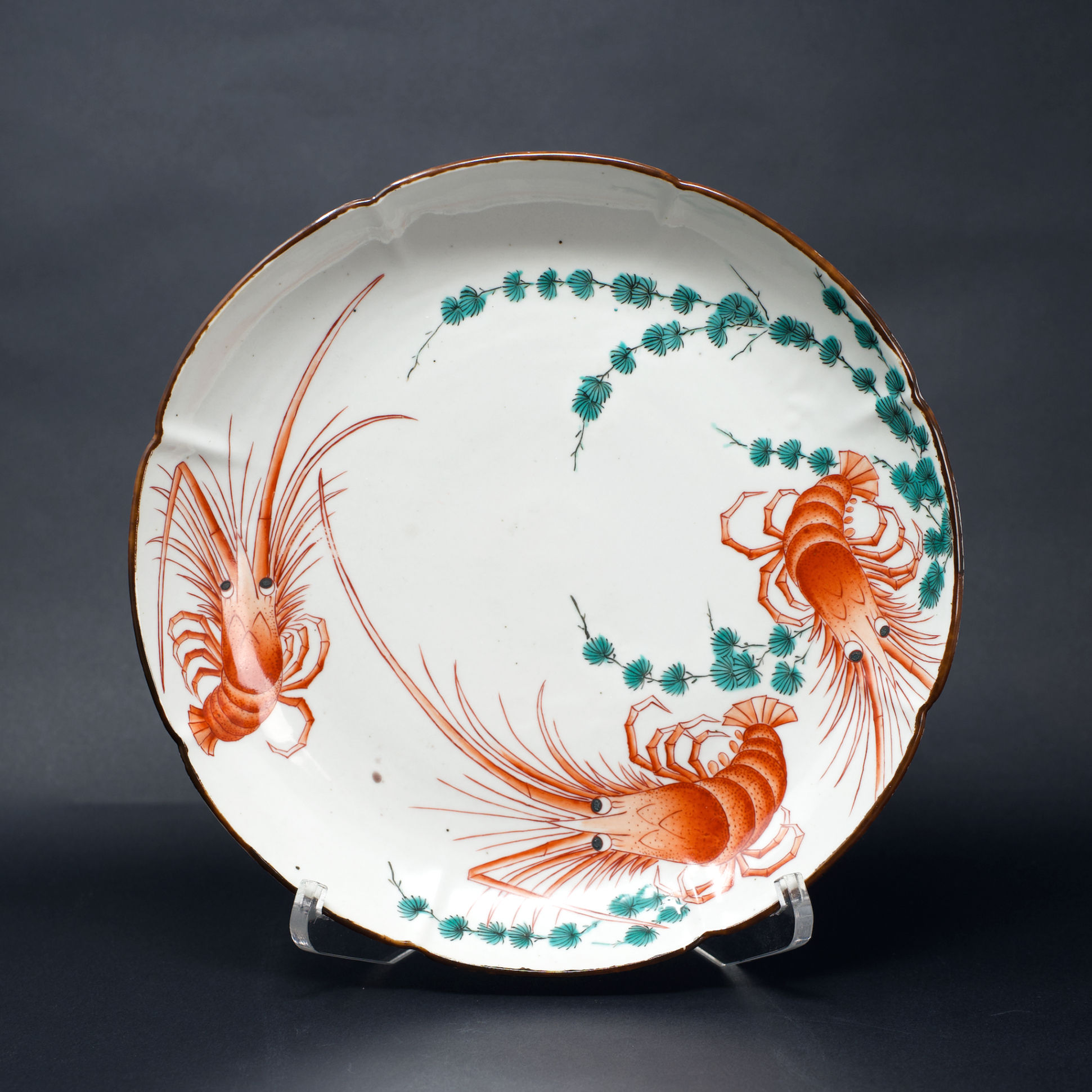

A large, impressive and dynamically executed lobed Kakiemon dish strikingly enamelled with three Japanese tiger prawn (kuruma-ebi) and trailing seaweeds
Arita kiln, Kakiemon workshop, Hizen province, Japan Edo period, Enpo era (1673-1681) - Genroku era (1688-1703)
circa 1670-1690
MEASUREMENTS
23.5 cm diameter; 4.0 cm high
CONDITION
In excellent original condition.
DESCRIPTION
The asymmetrical placement of boldly rendered Japanese tiger prawns is grounded by the delicate brilliant-green enamelled trailing seaweeds that wrap around the outer edge of the dish to the reverse. The elegantly lobed form is edged with a classic iron-oxide fuchi-beni rim, and the footrim encircled with red concentric rings. A very rare, striking and very impressive dish with a bold presence.
During the Edo period, the Japanese tiger prawn (kuruma-ebi) played an integral role in shaping traditional Japanese food culture. The large tiger prawns were caught in the warm waters of Tokyo Bay (then called the Edo Sea) and became the defining symbol of luxury for the booming city of Edo (modern-day Tokyo) as a key element in the establishment of the Edomae (Edo-style) sushi experience. Early sushi masters discovered that boiling the tiger prawn brought out a bright, beautiful red colour which quickly became one of the most prestigious, essential toppings for authentic Edomae sushi. The large prawns were a highly prized delicacy and a symbol of high-class dining.
STORAGE
With a traditional Japanese wooden tomobako storage box and silk ribbon.
A striking Kakiemon dish enamelled with tiger prawns & seaweeds, Arita c1670-90
SOLD
BARASET HOUSE FINE ART
416 666 6295
info@barasethouse.com
www.barasethouse.com
COMPARABLE EXAMPLES
A slightly smaller blue & white version of this dish with identical pattern titled as "The Lobster Design Plate" is illustrated in Kazuo Seki's Beauty of Prime Period Imari: selected works of under-glazed blue porcelain (Tokyo 1990), catalogue number 104, p.45. This Ai-Kakiemon (blue and white) version is marked with the Kakiemon kiln Kin (gold) mark, noting its high value and importance. The present enamelled version is even rarer and more desirable.
Another slightly smaller blue & white version of this dish with identical pattern dated 1670-90 and titled "Lobed dish with Shrimp & Water Plant design" is in the Shibata Collection at the Kyushu Ceramic Museum (Arita, Japan), illustrated in Complete Catalogue of Shibata Collection (2019), no.1601. It is noted that the Shibata example is a rare Ai-Kakiemon dish, however the present example being larger and coloured (enamelled) is significantly rarer and more desirable than the Shibata blue and white example.